Security for Rural Properties

Rural properties across Hertfordshire enjoy space, privacy, and countryside views — but isolation works both ways. Response times are longer, neighbours may be hundreds of metres away, and a single driveway can stretch far beyond the reach of a standard Wi-Fi router. Security specification for a farmhouse near Ware differs fundamentally from a terraced house in Watford. This guide covers practical measures for countryside homes, smallholdings, and barn conversions.
Unique rural risks
Countryside properties face:
- Longer police response times — audible alarms and monitored systems matter more
- Multiple buildings — house, barns, stables, workshops each hold value
- Dark lanes and concealed approach — intruders visible only if cameras cover access routes early
- Agricultural equipment — quad bikes, tools, fuel stores
- Seasonal occupancy — second homes and holiday lets empty for weeks
- Wildlife false alarms — deer and foxes trigger poorly configured PIRs
Generic urban security packages rarely address these without a proper survey.
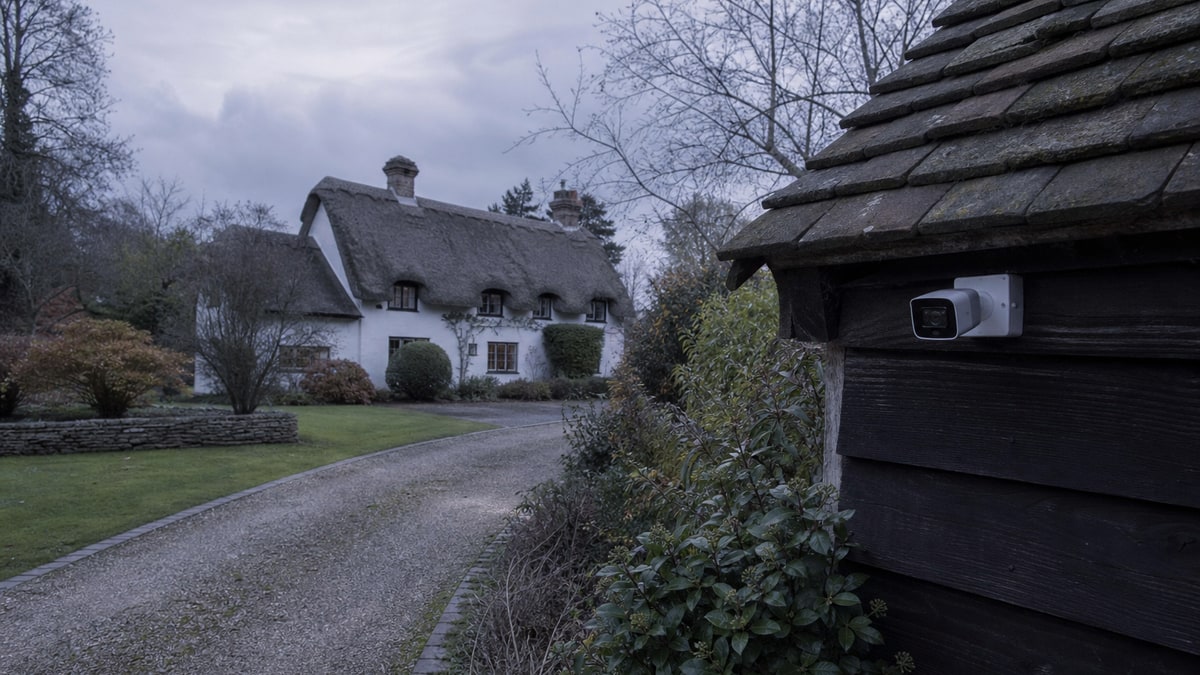
Driveway and access route coverage
The driveway is your early warning system. Specify:
- Camera at gate or entrance — capture vehicle direction, registration, and faces where lawful
- Secondary camera at house approach — confirms who continued up the drive
- Lighting triggered by motion — supports camera identification and deters casual intrusion
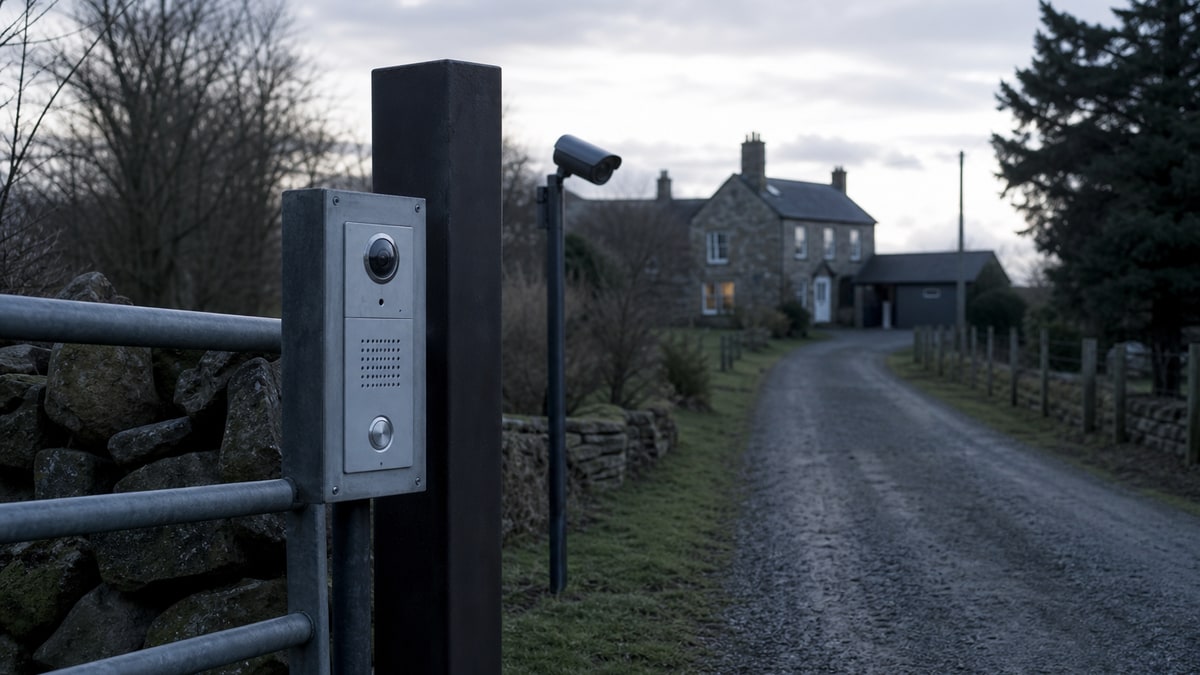
- Intercom or video call at gate — verify visitors before remote release if automated gates exist
Wired PoE cameras work when cable can run along fence lines or underground in duct laid during other works. Wireless CCTV with point-to-point links suits long distances without trenching.
We installed wireless coverage linking a Ware farmhouse to stables — see our wireless CCTV project for a reference layout.
Outbuildings and stables
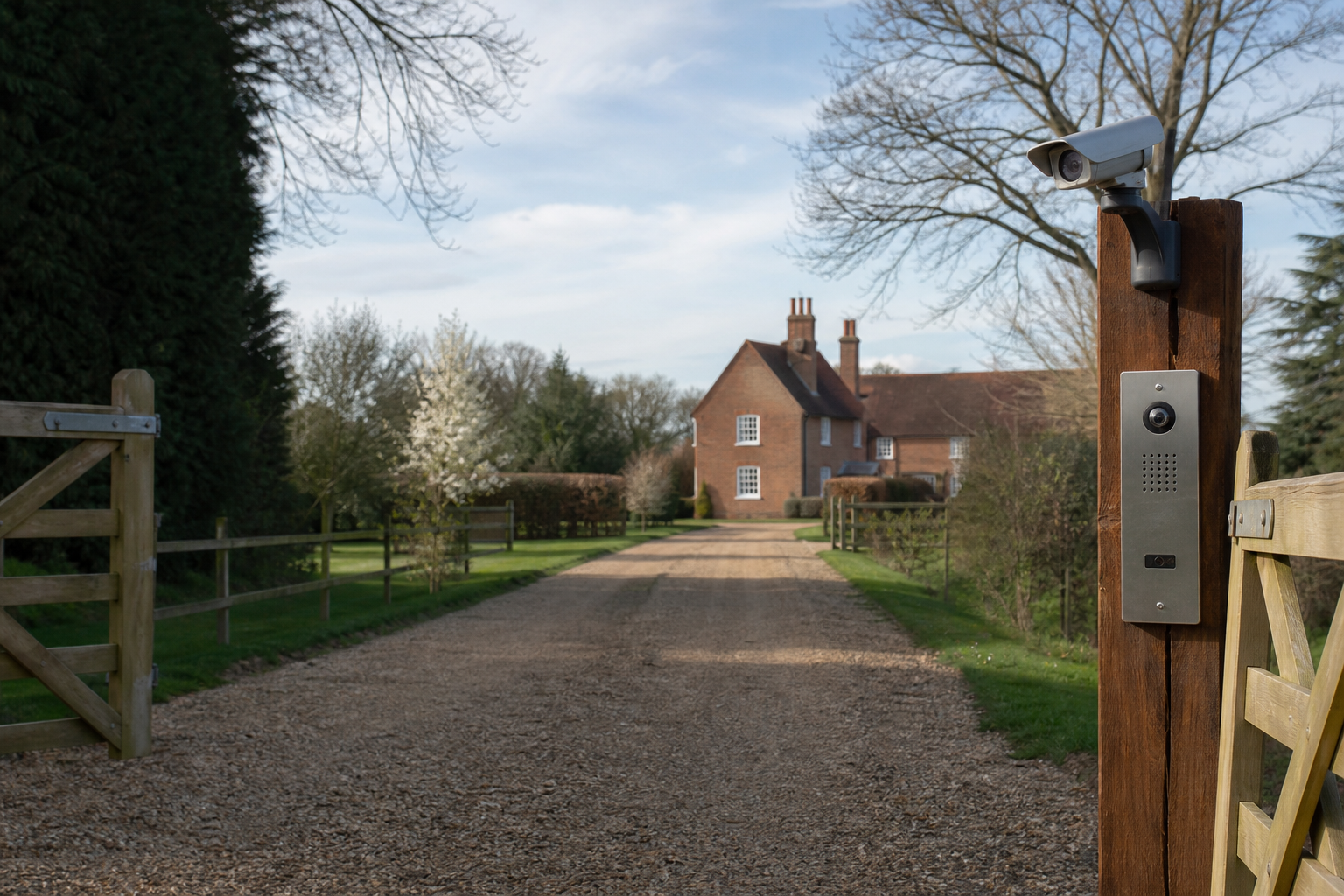 Gates and outbuildings often need separate coverage from the main house.
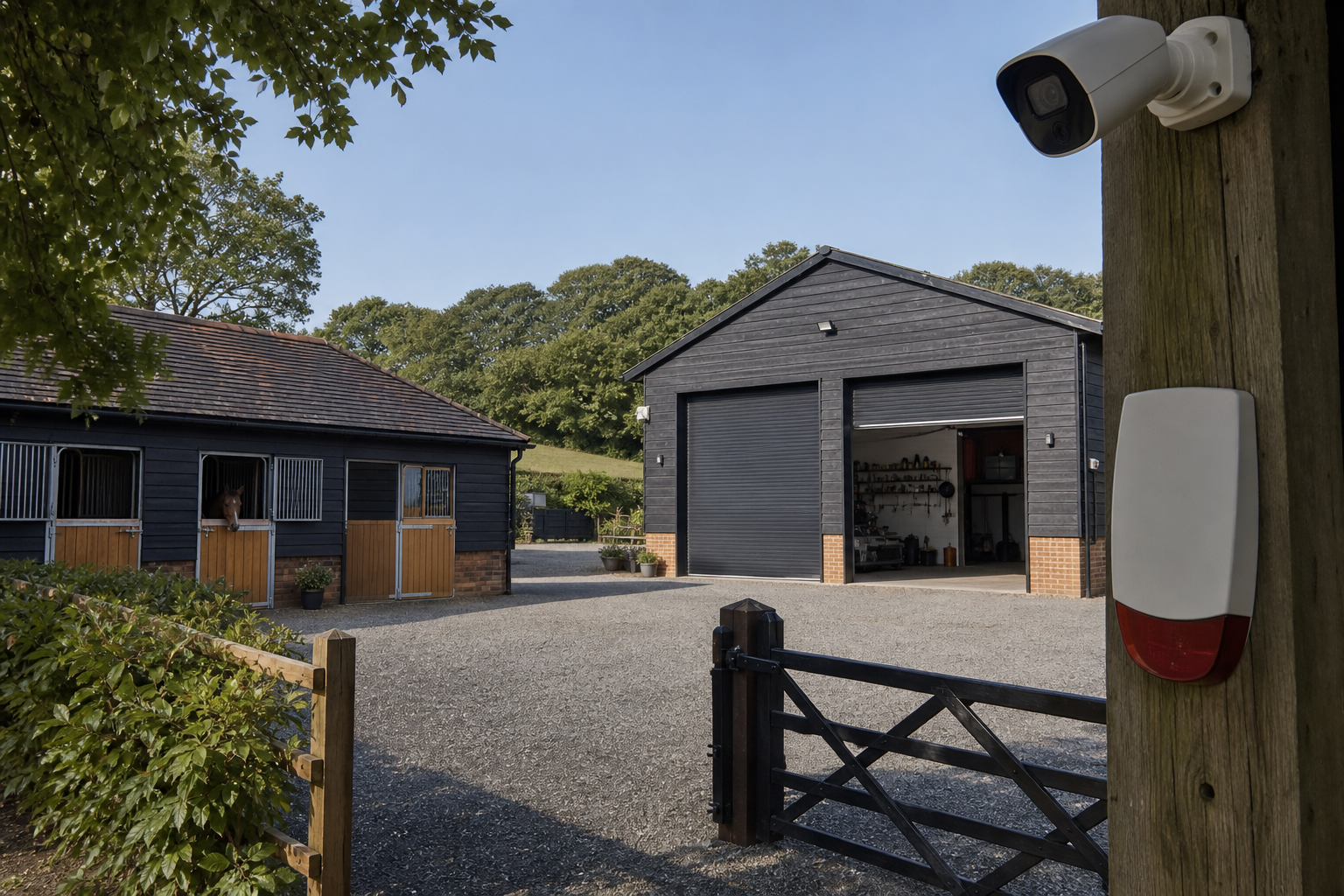 Partition alarms let you secure stables without arming the whole house.
Stables, workshops, and barns often sit 50–200 metres from the main house:
- Point-to-point wireless bridge from house to outbuilding
- Local cameras on stable doors, tack rooms, and workshop entrances
- Central NVR at the house records all feeds — one app, one retention policy
- Separate alarm zones on outbuildings if they store high-value equipment
Battery-only cameras can supplement coverage but require maintenance schedules — mains-powered where possible.
Intruder alarms in large footprints
House alarm systems on rural properties benefit from:
- Multiple partitions — house, annex, barn zones armed independently
- External contacts on stable and workshop doors
- Dual-path monitoring — cellular backup when broadband fails in rural exchanges
- External sounders on outbuildings — visible and audible across the yard
- Pet-friendly sensors where dogs roam ground floors
Night mode arms ground floor while owners sleep upstairs; annex zones stay active when guests occupy separate accommodation.
Broadband and remote viewing limitations
Rural FTTP and FTTC coverage improves but is not universal. Plan for:
- Local NVR recording — do not rely on cloud-only systems if upload speed is poor
- 4G backup routers for monitoring and remote access on critical systems
- Lower remote stream quality while maintaining full local recording resolution
Survey upload speeds before specifying cloud-dependent platforms.
Smart home security in the countryside
Smart home security integrates cameras, alarms, and smart locks — but geofencing and Wi-Fi depend on stable internet. Mesh networks or dedicated access points extend coverage to detached garages. Professional commissioning tests automations at the property edge, not just beside the router.
Video doorbells at farmhouses with long drives may need supplementary gate cameras — the doorbell alone sees visitors too late.
Perimeter considerations
Full perimeter fencing is not always desirable or permitted. Prioritise:
- Vulnerable boundaries near public footpaths
- Gates and vehicular access points
- Yard entrances between buildings
Continuous perimeter CCTV is expensive; layered coverage at access choke points delivers better value.
Agricultural and equestrian specifics
- Tack room locks and alarm contacts
- Fuel store within camera and PIR view
- Quad and trailer storage — ground anchors plus CCTV
- Seasonal staffing — revoke access when grooms or workers leave
Tool theft guidance in our preventing tool theft article applies equally to farm workshops.
Listed barns and conversions
Barn conversions in Hertfordshire conservation areas need discreet equipment:
- Wireless sensors minimise fabric disturbance
- Cameras on rear elevations where planning sensitivity is lower
- External sounders positioned to satisfy listed building constraints — see planning permission for CCTV
Monitoring when you are away
Extended travel is common for rural owners:
- ARC monitoring on alarms with keyholder or police response paths
- Regular recording checks via app — or maintenance contract verifying health remotely
- Smart lighting schedules simulating occupancy
- Trusted neighbour with visibility to driveway — technology supplements community
Power cuts and resilience
Rural lines suffer storms. UPS on NVR and router maintains recording through short outages. Alarm communicators with cellular paths operate when phone and broadband fail together.
Privacy and public rights of way
Footpaths crossing land require camera angles that minimise capturing walkers. Privacy masks and signage maintain compliance with UK GDPR — detailed in CCTV laws in the UK.
Choosing an installer who understands rural sites
Ask:
- Experience with wireless bridges and long cable runs
- Will you test Wi-Fi at the furthest outbuilding before quoting?
- Can monitoring work without reliable broadband?
- Do you maintain systems across scattered buildings?
We cover rural Hertfordshire from Broxbourne — including Hertford villages, Bishop’s Stortford fringes, and Harpenden countryside — with surveys that walk the full property, not just the house front.
Suggested priority order
- Entrance and driveway cameras
- Monitored alarm on house with key outbuilding contacts
- Wireless link and cameras on highest-value remote building
- Gate intercom if automated access exists
- Expand coverage and smart integration as budget allows
Own a rural property across Hertfordshire? Book a free site survey — we specify CCTV installation, alarms, and wireless links matched to your land and buildings.

