Business Security Checklist

Security for a Hertfordshire business is not a single product — it is layers of measures that match your risks, insurance requirements, and how staff actually work. A checklist helps directors, facilities managers, and shop owners identify gaps before an incident exposes them. Use this guide alongside a professional survey for commercial security systems tailored to your premises.
1. Risk assessment
Start with what you are protecting and from whom:
- Assets — stock, cash, IT equipment, intellectual property, tools
- People — staff safety, lone working, public access areas
- Premises — ground floor shop, upper offices, yard, loading bay
- Threats — burglary, shoplifting, internal theft, vandalism, cyber-physical breach (tailgating)
Walk the site at opening, midday, and closing. Note blind spots, doors left propped open, and cash handling routines. Businesses in Watford town centre face different risks from units on Hemel Hempstead industrial estates — local context matters.
Document findings. Insurers and auditors increasingly ask for written risk assessments.
2. Perimeter and entry control
Control who enters and when:
- Main entrance — intercom, video entry, or staffed reception
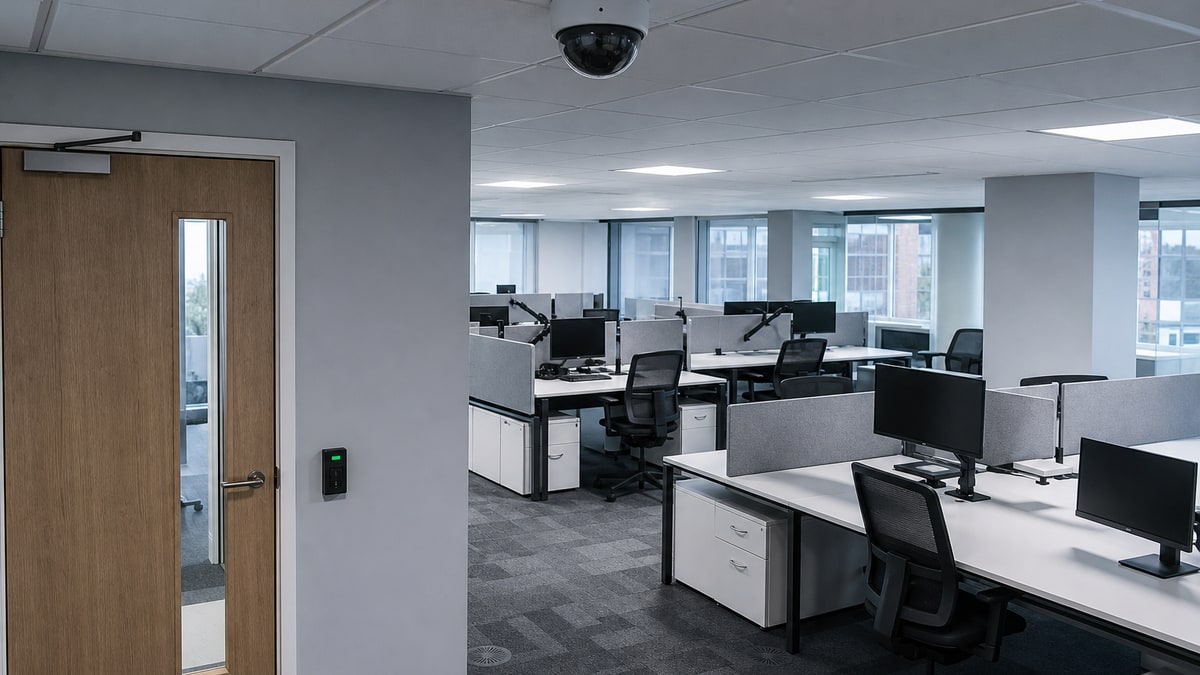
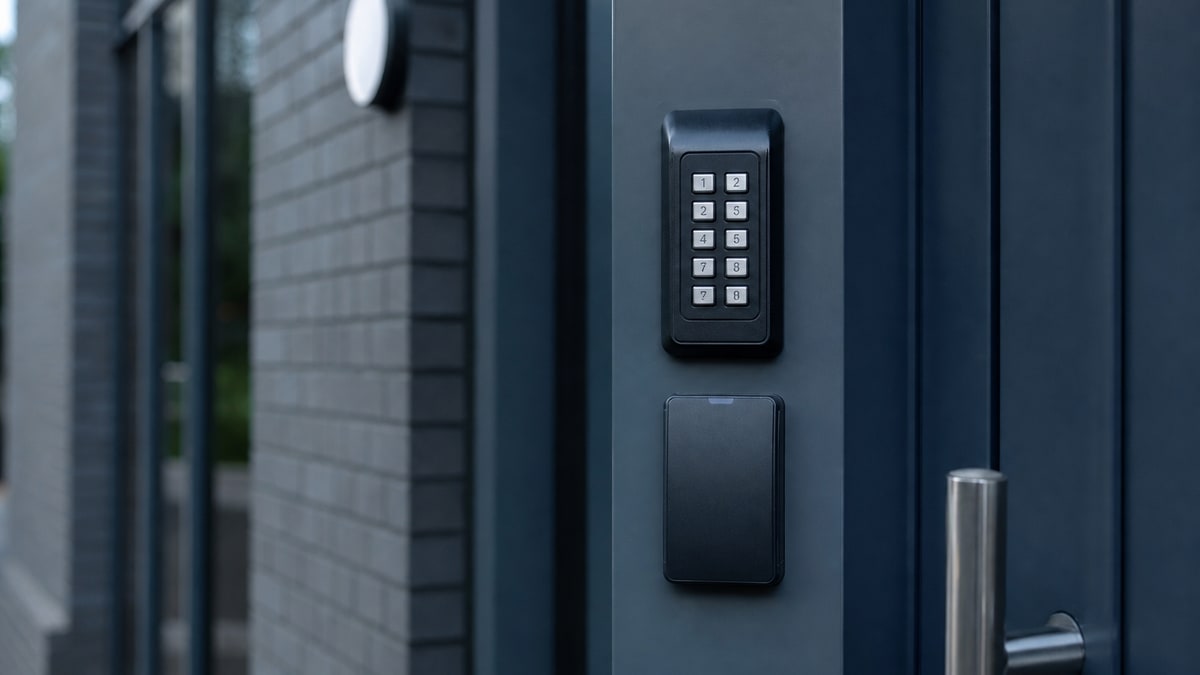
- Staff doors — fob or card access control rather than shared keys
- Loading bays — roller shutter contacts linked to alarm zones
- Visitor management — sign-in, escorted access, temporary credentials
Revoke fobs immediately when staff leave. Audit trails show who entered server cupboards and stock rooms — valuable after incidents.
3. CCTV coverage
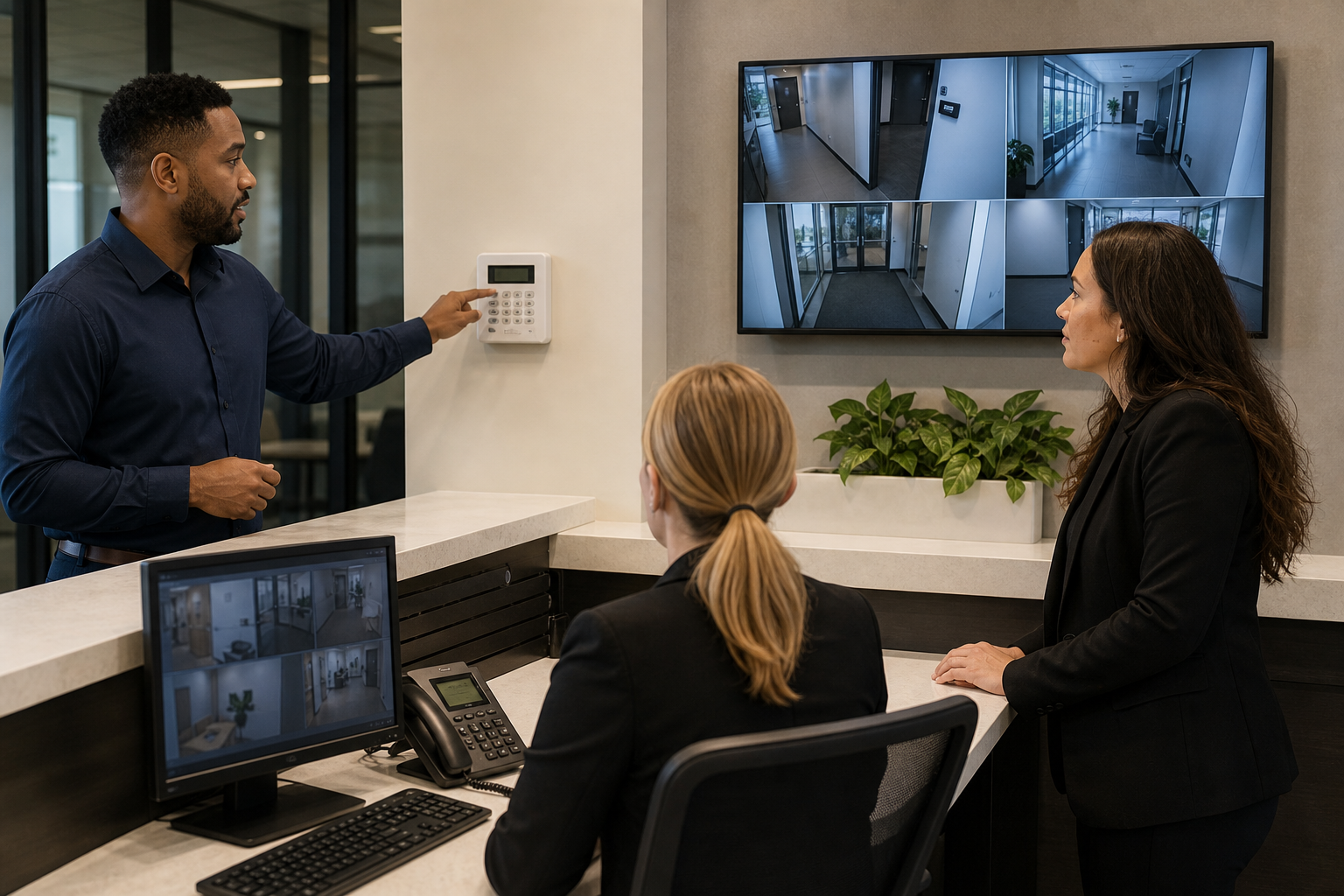 Procedures matter as much as hardware — train staff after installation.
 Quarterly credential audits catch revoked fobs still in circulation.
Cameras should cover:
- All public entry and exit points
- Tills and high-value displays (retail security)
- Stock rooms and goods inward areas
- Car parks and loading bays
- Server rooms and comms cabinets
Check image quality at identification distance — not just wide scene views. Retention of 60–90 days is common for commercial insurance. Secure remote access with strong authentication.
See business CCTV specification guidance and our portfolio of office security upgrades for examples.
4. Intruder alarm
Partition alarms so offices, warehouse, and showroom arm independently:
- Contact sensors on external doors and vulnerable windows
- PIR or dual-tech sensors in stock and server areas
- Audible external sounder as deterrent
- Dual-path monitoring where insurer or lease requires ARC response
Test weekly arming routines. Alarms that staff find awkward get skipped — design zones around shift patterns.
5. Lighting
Security lighting supports CCTV and deters intruders:
- Even illumination at entrances — avoid harsh shadows on faces
- Motion-activated lighting at rear and side access
- Coordinate with camera positions — glare into lenses ruins night footage
- Timer or smart controls for holidays and short winter days
6. Safes, cash, and high-value stock
- Cash kept overnight minimal; safe anchored and alarmed where possible
- High-value stock in locked areas with separate alarm partition
- Display items tethered or caged where shoplifting risk is high
- Tool stores on trade premises — see preventing tool theft
7. Staff training and procedures
Technology fails without procedures:
- Opening/closing checks — doors, alarms, CCTV recording indicator
- Lone working policy — panic buttons, check-in calls, restricted hours
- Key and fob issue — log who holds credentials
- Incident response — who reviews CCTV, when to call police, preserve footage
- GDPR — staff know cameras exist and how footage is used
Run brief refreshers after staffing changes.
8. Cyber-physical security
Remote access to CCTV and access control systems is an attack surface:
- Unique passwords and two-factor authentication
- Separate VLAN for security devices where IT allows
- Disable unused ports and default accounts
- Update firmware during maintenance visits
9. Insurance and compliance
Confirm policy requirements:
- Minimum alarm grade and monitoring
- CCTV retention periods
- Maintenance contract evidence
- Fire and security separation — do not disable alarms during building works without notifying insurers
Landlords may impose additional conditions on office security in multi-tenant buildings across St Albans and Bishop’s Stortford.
10. Maintenance schedule
| Task | Frequency |
|---|---|
| Test alarm arming and sensors | Weekly (staff) |
| Verify CCTV recording | Weekly (staff) |
| Professional alarm service | Annual |
| CCTV health check and lens clean | Annual or quarterly |
| Access control user audit | Quarterly |
| Review risk assessment | Annually or after incident |
Failed cameras discovered during an investigation are worthless. Planned maintenance costs less than one uninsured loss.
11. Warehouse and yard specifics
Warehouse security adds:
- Perimeter fence-line cameras
- Separate zones for office, stock, and plant
- HGV and loading bay coverage
- Integration with security lighting
- Remote monitoring for sites unmanned overnight
12. Response and review after incidents
If something happens:
- Preserve footage — export relevant clips immediately
- Do not wipe recordings during retention period
- Report to police with reference numbers
- Review what failed — blind spot, propped door, revoked fob still active?
- Update checklist and procedures
Quick checklist summary
- Written risk assessment
- Entry control on staff doors
- CCTV at entries, tills/stock, car park
- Alarm with appropriate monitoring
- External lighting coordinated with cameras
- Staff trained on arming and incidents
- Credentials revoked promptly
- Maintenance contracts active
- Insurance requirements documented
- Annual review scheduled
Want a checklist tailored to your premises? Book a free security survey — we assess Hertfordshire offices, shops, and warehouses and propose integrated CCTV, alarm, and access solutions.

